
In April 2016, Dr. Torres-Reveron performed the nation’s first spine surgery using Montpellier, France-based Medtech’s ROSA Spine. The technology guided him as he performed a 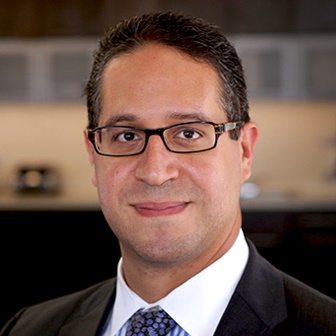 spinal fusion, allowing him to make 1.5 inch incisions and adjusting for patient movement.
Dr. Torres-Reveron became acquainted with ROSA technology back in his residency and fellowship days at Yale New Haven (Conn.) Hospital.
“We used ROSA Brain during the time I was at Yale, so it was a natural extension,” explains Dr. Torres-Reveron. “It was an easy transition, and during training I did a lot of minimally invasive surgery.”
Dr. Torres-Reveron believes robotic spine surgery is positioned to transform how surgeons perform minimally invasive spine surgery, and predicts ROSA Spine will follow the success of ROSA Brain, which the FDA approved in 2012.
“With everything in technology, there is always a flat curve at the beginning,” Dr. Torres-Reveron says. “But surgeons will push forward to do more surgeries in other areas of the spine [with the technology].” Currently, ROSA Spine is only approved for lumbar spine surgery.
To match its surgeons’ talent, Miami Valley Hospital stays at the frontline of new technology. The hospital acquired the first ROSA Spine in the United States after it received FDA clearance in January 2016.
The hospital’s Brethen Center for Surgical Advancement in Robotics and Minimally Invasive Surgery offers visiting surgeons a chance to test out their curiosity of cutting-edge technology. Interested surgeons may take an immersive robotics course on workflow and learn how to use the technology.
“We have to do the leap of faith,” says Dr. Torres-Reveron of performing the first ROSA Spine cases. “[Other surgeons] just have to come and watch.”
If performing MIS cases, Dr. Torres-Reveron doesn’t believe the robotic-guided surgery learning curve is too steep. And if not performing MIS cases, he says robotics will help surgeons learn the MIS approach faster.
“It’s just a computer,” says Dr. Torres-Reveron. “If anything, the hardest part is going to be trusting. You have to trust the robot and believe it’s going to be correct.”
More articles on devices:
Global orthopedic device market to reach $43.1B by 2024: 8 key trends
More for-profit hospitals’ physicians take pharma, device company payments than nonprofit counterparts & 4 other key findings
Aurora Spine grants stock options to acquire 1M common shares: 3 points
At the Becker's 23rd Annual Spine, Orthopedic and Pain Management-Driven ASC + The Future of Spine Conference, taking place June 11-13 in Chicago, spine surgeons, orthopedic leaders and ASC executives will come together to explore minimally invasive techniques, ASC growth strategies and innovations shaping the future of outpatient spine care. Apply for complimentary registration now.
